
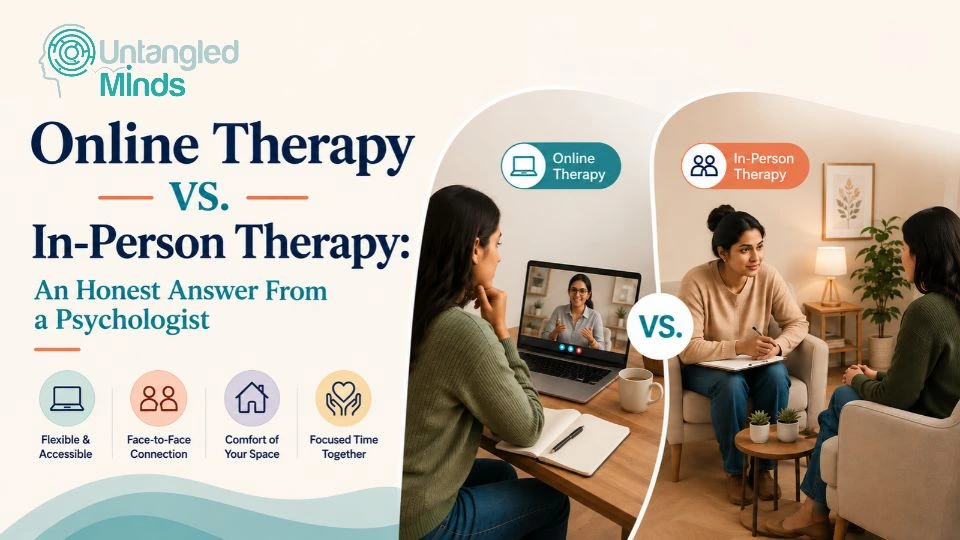
Before you decide whether therapy should happen through a screen or in the same room as your psychologist, consider something we rarely question in other parts of life. We don’t usually ask whether a phone call is as “real” as meeting someone in person. We choose the format that works for the conversation.
Therapy is more complicated, because the setting can affect how comfortable you feel, how much you share, and how the therapist works with you. So the question of online therapy vs in person therapy is worth answering properly.
Is online therapy real therapy? Yes. Can in-person therapy sometimes be more appropriate? Also yes.
After working with children, adolescents and adults in both hospital and private settings, I’ve found that the most useful question isn’t which format is better. It’s which format allows you to engage honestly and consistently with the kind of support you need.
What’s Actually Different Between Online and Face-to-Face Therapy?
At first glance, the difference seems obvious. In one case, you sit in a room with your psychologist. In the other, you sit in front of a screen.
But the setting changes more than the physical distance.
With face to face therapy, there is a physical separation between your everyday environment and the therapy space. You leave home, travel to an appointment, sit somewhere specifically meant for therapy, and then return to your routine. For some people, that transition is useful. It creates a psychological boundary around the session.
In person therapy can also make it easier for some people to remain focused. There are fewer interruptions from household responsibilities, notifications, family members or the temptation to check your phone.
Online therapy changes that experience.
You might attend from your bedroom, study, office or another private space. You don’t have to spend an hour travelling through Mumbai traffic to attend a 45-minute appointment. You can finish your session and return to your day almost immediately.
The actual therapeutic conversation, though, doesn’t have to be fundamentally different.
I can still ask questions, notice patterns in what you’re saying, challenge unhelpful thoughts, explore relationships, work through emotions and help you develop practical strategies. The therapeutic relationship still matters just as much.
What changes is the environment in which that work takes place.
And that difference can be either helpful or unhelpful, depending on you.
Where Online Therapy Has a Genuine Edge
I don’t think online therapy should be sold as simply being “just as good” as in-person therapy in every situation. It has some advantages that are genuinely different.
The first is convenience.
If you live in Mumbai, you already know that getting somewhere can take considerable time. A session that takes 50 minutes can easily become a two-hour commitment once you include getting ready, travelling, parking and returning home.
With therapy from home, that barrier largely disappears.
This can make it easier to attend sessions consistently, particularly if you have a demanding job, children, unpredictable working hours or physical limitations.
There’s also something surprisingly useful about being in your own environment.
I remember working with a client who was initially quite guarded during sessions. When we moved to online sessions because of a change in her schedule, she gradually became more open. She wasn’t suddenly a different person. She simply felt more comfortable speaking from a familiar environment.
She once mentioned that she found herself saying things online that she had struggled to say while sitting across from someone in a consulting room.
That isn’t true for everyone. Some people feel more comfortable in person. But it’s a useful reminder that the physical therapy room isn’t automatically the safest setting for every client.
Another of the important online therapy benefits is continuity.
You may travel frequently for work. You may move cities. You may spend several months away from Mumbai. If your therapist is able to continue working with you online and it remains clinically appropriate, therapy doesn’t necessarily have to stop because your location has changed.
For some people, that continuity is more valuable than the format itself.
Where In-Person Still Matters More
Here’s where I want to be honest: there are situations where I would not automatically recommend online therapy.
Some presentations require a greater level of support, observation or coordination than online sessions can comfortably provide. If someone is experiencing severe psychological distress, significant functional deterioration, acute risk, or symptoms requiring more intensive intervention, an in-person assessment may be more appropriate. In some circumstances, additional psychiatric or emergency support may also be necessary.
Children are another example.
While online therapy can work well with older children and adolescents in appropriate circumstances, younger children often benefit from being physically present. Their communication may happen through play, drawing, movement and behaviour rather than conversation alone. A physical setting can provide opportunities that are difficult to recreate through a screen.
Certain kinds of trauma-focused work may also benefit from an in-person setting, depending on the individual, the therapeutic approach and the stage of treatment.
This is why I’m cautious about making sweeping claims about therapy effectiveness.
The effectiveness of therapy isn’t determined by whether there is a screen between you and your psychologist. But the format can influence how comfortably and safely particular therapeutic work can be carried out.
Sometimes online is perfectly appropriate.
Sometimes in-person is preferable.
And sometimes the right answer changes as therapy progresses.
The Cost Difference and Whether It Changes What You Get
One of the practical reasons people choose online therapy is cost.
Online sessions are often more accessible because there are fewer overheads associated with maintaining a physical consulting space, and clients also save on travel and the time involved in commuting.
But does paying less mean you receive lower-quality therapy?
Not necessarily.
The therapy cost and the quality of psychological care are not the same thing.
A qualified psychologist should still bring their training, clinical experience, therapeutic approach and professional judgement to an online session. The fact that you are sitting at home rather than in a consulting room doesn’t mean the psychologist suddenly has less knowledge or experience.
At the same time, price shouldn’t be the only factor you consider.
A very inexpensive service may not necessarily be the right fit for your needs, while a higher fee doesn’t automatically mean better therapy either.
When comparing therapists, I would look beyond the number on the payment page. Consider their qualifications, experience with your concern, therapeutic approach, availability and whether you feel comfortable communicating with them.
Therapy is an investment of both money and emotional effort. The format is only one part of that decision.
Who Should Choose Online and Who Should Choose In-Person?
If you’re trying to decide between the two, I would start with your actual circumstances rather than a general rule.
If travelling to appointments is exhausting, your work schedule is unpredictable, you travel regularly or you feel more comfortable talking from your own space, online therapy may suit you very well.
If you find yourself distracted at home, don’t have a private place to talk, or feel that physically leaving your environment helps you switch into a therapeutic mindset, an in-person appointment may be more useful.
Your concern matters too.
For many adults experiencing anxiety, low mood, relationship difficulties, work stress, adjustment concerns or other common psychological concerns, online therapy can be a practical option.
If the concern is more complex, severe, involves significant risk, or requires a type of assessment or intervention that is better conducted in person, I may recommend face-to-face work instead.
A psychologist consultation should begin with understanding what you need, rather than deciding beforehand that one format is always better.
And if you’re searching for a therapist near me, remember that “near” isn’t necessarily the same as “right for me”. A psychologist who is a good clinical fit and offers an appropriate format may be more useful than someone whose office happens to be five minutes away.
Can Online Therapy Work for Anxiety and Depression?
Yes, online mental health counselling can be appropriate for many people experiencing anxiety or depression.
The important word is many, not everyone.
Therapy for anxiety or depression isn’t simply about talking to someone on a video call. It involves understanding the patterns maintaining your difficulties and choosing interventions suited to your particular concerns.
For some people, online sessions provide enough privacy, structure and continuity to do this effectively. For others, meeting in person makes it easier to engage.
I’ve written more about understanding anxiety and depression and when professional support may be useful in my earlier blog on the topic, which can help you understand whether what you’re experiencing may warrant further attention.
Psychologist in Mumbai – When You Want Both Options
One advantage of working with a psychologist in Mumbai who offers both online and in-person sessions is that you don’t necessarily have to make the decision permanent.
For example, you might begin therapy online because getting to an appointment is difficult. Later, you may decide that meeting in person would be more helpful.
Or perhaps you prefer face-to-face sessions but need to switch online temporarily because you’re travelling.
At Untangled Minds, I offer both online and in-person psychological sessions. In-person appointments are available in Chembur, Sion, Wadala and Santacruz, while online sessions allow you to attend from wherever you are.
The aim isn’t to push you towards one format.
It’s to find a way of working that you can realistically maintain.
What to Look For in an Online Therapist Before Booking
Choosing an online psychologist shouldn’t be reduced to finding someone whose calendar has an available slot tomorrow.
Start with qualifications.
Make sure the psychologist has appropriate professional training and experience relevant to the concerns you want help with. If you’re looking for support for a specific concern, it’s reasonable to ask whether they have experience working with similar presentations.
Then consider their therapeutic approach.
You don’t necessarily need to find someone who uses one particular technique. But you should have some idea of how they work and whether their approach makes sense for what you’re looking for.
I also think it’s completely reasonable to ask practical questions before beginning online counselling. How long are sessions? Which platform is used? What happens if the connection drops? How is confidentiality handled? Can you switch to in-person sessions if appropriate?
And then there’s something that is harder to measure on paper: how you feel while speaking to them.
You don’t have to feel completely at ease in the first five minutes. Therapy can feel a little uncomfortable at first, especially when you’re talking about things you don’t usually share with people. What matters is that, over time, you start to feel safe enough to be honest without worrying about being judged, criticised or dismissed.
If you have the opportunity for an initial or trial conversation, use it to get a sense of whether the psychologist’s communication style and approach work for you.
You’re not simply choosing a time slot.
You’re choosing the person with whom you’ll be discussing some of the more private parts of your life.
About Shyamolie Desai
I’m Shyamolie Desai, an independent Clinical Psychologist based in Mumbai, with over 13 years of experience across hospital psychiatry and private consultant practice.
I’ve worked with children, adolescents and adults across a range of psychological concerns. My approach is evidence-based and eclectic, which means I draw from different therapeutic approaches depending on the person and the concerns they bring to therapy.
I offer both online and in-person sessions. In-person sessions are available in Chembur, Sion, Wadala and Santacruz, while online sessions can be conducted from wherever you have a suitable private space.
I don’t see online and in-person therapy as competing versions of psychological care. The more useful question is which setting allows you to engage comfortably, consistently and meaningfully with the therapeutic process.
Conclusion
So, online therapy vs in person therapy: which one should you choose?
There isn’t an honest universal answer.
For some people, online therapy removes practical barriers that might otherwise prevent them from seeking help. For others, physically entering a therapy space makes it easier to concentrate, feel separate from everyday responsibilities and engage with difficult emotions.
Neither format automatically makes therapy more effective.
What matters is whether the setting feels right for what you’re dealing with. You should feel comfortable enough to be honest during your sessions. It also helps if you can attend regularly, so that therapy has a chance to actually work.
Sometimes the best therapy is the one you can realistically keep showing up for.
And sometimes, as your circumstances or needs change, the best format can change with you.
Frequently Asked Questions
Is online therapy covered by insurance in India?
Insurance coverage for psychological therapy varies considerably between policies and providers. Some health insurance policies cover mental health issues, but it depends on the company and their policy. The rules can vary depending on the company or provider and the type of treatment required.
Before you start therapy, check with your insurance company and your policy. Ask specifically whether online sessions with a psychologist are covered and how reimbursement works.
Can I switch from online to in-person sessions with the same therapist?
Yes, you usually can. It depends on where you are based and whether the psychologist offers in-person sessions within the same city. You can schedule an appointment based on your availability and theirs, after discussing your needs. This can work well if your circumstances change or you need a different format for a while. It’s worth discussing this with your psychologist rather than assuming you have to choose one format permanently.
Does online therapy work for couples?
Online couples therapy can work well for many relationship concerns, provided both partners have a private and reasonably distraction-free space to participate. It can be really helpful when partners have different schedules or live in different places. At the same time, some couples simply feel more comfortable meeting face to face. This can be especially true when there’s a lot of tension or conflict in the relationship.
What if there isn’t a private space at home for online sessions?
Privacy is important. If you’re regularly worried about someone overhearing you, you may find it difficult to speak openly. You could consider using a private room, your car while parked somewhere safe, or another confidential location. If privacy remains difficult to maintain, in-person therapy may simply be a better option for you.
Is online therapy suitable for teenagers?
It can be, especially for older teenagers who are comfortable talking online and have a private space for their sessions. With younger adolescents, it may need a little more flexibility. Depending on what they’re dealing with, some parental involvement may also be needed. The psychologist should consider the teenager’s age, maturity, presenting difficulties, privacy and safety before deciding whether online therapy is appropriate.